Hey there, if you’ve ever worked with small pneumatic tools—think handheld grinders, robotic assembly grippers, or even compact lab air-powered devices—you’ve probably used a mini pneumatic quick coupling without even noticing it. I’m a supplier of these tiny game-changers, and I get it: most people just grab one, snap it on, and get to work. But have you ever stopped to wonder how something so small keeps air from leaking, connects in half a second, and doesn’t fall off mid-use? Today, let’s break it down like we’re chatting over a coffee, no jargon overload, I promise. Mini Pneumatic Quick Couplings
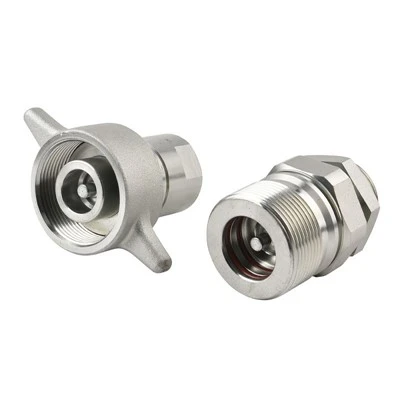
First, let’s set the scene: a mini pneumatic quick coupling isn’t just a smaller version of a regular big coupling. Regular ones are for heavy industrial stuff—like 1-inch hoses running to air compressors for construction jackhammers. Mini ones are, well, mini—usually 1/8-inch to 1/4-inch size, built for tight spaces where every inch matters. They’re used everywhere from medical device manufacturing (think small assembly lines for insulin pens) to hobbyist 3D printer setups, even remote-controlled pneumatic aircraft models. If your space has a tiny pneumatic tool that needs fast tool changes, this is the part holding it all together.
So how does this tiny magic work? Let’s start with the two main parts you actually see when you pick one up: the plug (the part that connects to your tool or hose) and the coupler (the part you press the button on to connect/disconnect). Both are super simple on the outside, but inside, they have a few key pieces that make it all click.
First, the plug. It’s a metal pin, usually brass or stainless steel (we use both depending on if the customer needs corrosion resistance, like for food processing environments), with a little rubber O-ring around the middle, and a couple of raised rings on the end that stick out a tiny bit. That’s not just for show—those rings are called grip rings, and they’re what lock the plug into the coupler once it’s connected.
Now the coupler—this is where the real action happens. Inside the coupler housing (most are zinc alloy or lightweight aluminum for mini sizes, since weight matters for small tools), there’s a spring-loaded valve pin. This pin is what stops air from leaking when the plug isn’t connected. Normally, when there’s no plug in the coupler, the spring pushes the valve pin all the way forward, sealing the air port so compressed air can’t escape. That’s a big deal—imagine if every time you unhook a tool, your air line keeps blowing, wasting money and making a loud mess. We get tons of inquiries from folks who had cheap couplings that leak, and trust me, the design difference is night and day.
Now, when you push the plug into the coupler, here’s the sequence that happens in like half a second: first, the tip of the plug hits the valve pin in the coupler, pushing it back against the spring. That opens up a hole for air to flow through. Then, the grip rings on the plug slide past a set of steel ball bearings that sit evenly spaced around the inside of the coupler. Those ball bearings are the lock—they’re held in a little channel in the coupler housing, so when the plug is pushed all the way in, the spring around the balls pushes them inward, fitting into the groove on the plug. That’s the lock that keeps the plug from accidentally coming loose, even if you yank on the tool a little. No one wants a tiny grinder going flying mid-use, right?
When you want to disconnect? You press the little thumb lever on the side of the coupler (that’s the button everyone pushes) and that lever pushes a ring around the ball bearings outward, so the balls can slide out of the plug’s groove. At the same time, the valve pin spring pushes back forward, sealing the coupler’s air port right away, so no air escapes. That’s the whole process—connect in 0.2 seconds, disconnect in 0.3, zero leaks, zero fuss.
Wait, but why does this matter for mini couplings specifically? Let’s be real—smaller parts mean more design challenges. If you shrink a regular coupling down to 1/8-inch size, you can’t just use a tiny spring and tiny ball bearings—they have to be precision-made. If the ball bearings are even 0.001mm off, they won’t lock right, or they’ll get stuck. That’s why most cheap mini couplings fall apart fast—they cut corners on precision parts. We test every batch of our couplings to make sure the balls lock in consistently, no wobbly connections, no leaks.
I also get asked all the time: why not just use a regular coupling for small tools? Let’s do a quick comparison. A standard 3/8-inch coupling is bulky—you can’t fit it on a small robotic gripper that has a 5mm air line port. It’s heavy, too, so adding it to a lightweight handheld tool would make it awkward to use all day. Mini couplings are made for tight spaces, low weight, and fast changes, which is exactly what most modern industries need these days. No more fumbling with wrench tools to tighten a big coupling—just snap, done.
Another thing people don’t talk about: the seal. That O-ring on the plug I mentioned earlier? It’s not just a gasket. For mini couplings, the O-ring has to be the right durometer—meaning the right hardness. If it’s too soft, it gets compressed too much, wears out after a hundred connects/disconnects. If it’s too hard, it doesn’t form a good seal, so you get leaks. We use EPDM and Viton O-rings depending on the application—EPDM is great for general use, Viton holds up to extreme temperatures and chemicals, like in aerospace or chemical manufacturing. That’s the kind of detail you only learn when you’re actually making these parts, not just selling them.
Wait, let’s address a common myth: some people think quick couplings are only for disposable use. Nope—good mini couplings can handle thousands of connects and disconnects without failing. We test ours for 10,000+ cycles, and even after that, most still seal tight. The trick is the ball bearings and valve pin—if they’re made from hardened steel, they don’t wear out as fast as cheap steel that rusts or bends after a few uses.
Now, let’s talk about when you’d actually need a mini pneumatic quick coupling. If you’re a mechanic changing air tools on a line every 10 minutes, mini ones are way faster than threading a hose on every time. If you’re a hobbyist building a pneumatic robot, you don’t want bulky parts weighing down your design. If you’re in the medical field, you can’t have big couplings getting in the way of sterile assembly lines. Even gardeners use them for small air-powered sprayers that need to hook up to a compressor for quick refills. The uses are everywhere, even if you don’t see them.
I’ve seen so many mistakes people make when choosing these, too. First, size: make sure your coupling matches your hose size. A 1/8-inch plug won’t fit a 1/4-inch coupler, that’s basic but I still get calls from people who ordered the wrong size. Second, material: if you’re using it in a wet environment, like a car wash, stainless steel is way better than brass, which will corrode. Third, pressure rating: mini couplings can’t handle the same pressure as big industrial ones—most are rated for 100 to 150 PSI, which is perfect for small tools, but don’t try to use one on a 200 PSI compressor line. That’s a fast way to get a leak or a broken part.
Another thing: connection consistency. If you’re using couplings for a production line, you need every connection to lock the same way every time. We make sure that the ball bearings seat in the same groove every single time, so there’s no variation. Some cheaper brands have ball bearings that are inconsistent, so one coupling locks tight and the next one is loose, leading to downtime. That’s the kind of problem that costs factories money, so investing in a good mini coupling is actually a cost-saver in the long run.
Let me wrap this up: a mini pneumatic quick coupling is a simple but precision-made part. It works because of three core components: a spring-loaded valve that seals air when disconnected, steel ball bearings that lock the plug in place, and a calibrated O-ring that stops leaks. It’s built for speed, small spaces, and reliability, which is why it’s such a workhorse in so many industries these days.
If you’re shopping for mini pneumatic quick couplings, whether for a small tool, a production line, a hobby project, or something else, we’ve got options for every use case. No generic parts, no cutting corners, just couplings that work when you need them to. If you want to chat about your specific application, need help picking the right size or material, or just have questions, feel free to reach out to connect and work out your needs. Don’t settle for couplings that leak, break, or don’t fit your space—get ones designed for mini pneumatic use.
Agricultural Hydraulic Quick Couplings References
- Pneumatic Tube Fittings and Couplings: Design, Application, and Testing, Industrial Fluid Power Association, 2021.
- Miniature Coupling Performance Standards, Aerospace Industries Association, 2022.
- Corrosion Resistance of Pneumatic Coupling Materials, Food and Drug Administration Manufacturing Guidelines, 2023.
- Small Pneumatic System Efficiency: Leak Reduction and Component Selection, Occupational Safety and Health Administration, 2020.
- Precision Components for Miniature Pneumatic Devices, Journal of Manufacturing Science and Engineering, 2021.
Cixi Poolke Hydraulic Pneumatic Co., Ltd.
Cixi Poolke Hydraulic Pneumatic Co., Ltd. is one of the most professional mini pneumatic quick couplings manufacturers and suppliers in China, also supports customized service. Please feel free to wholesale the newest mini pneumatic quick couplings made in China here from our factory. Quality products and reasonable price are available.
Address: #88 Zhengtong Road, Kandun Industrial Park315303, Cixi, Zhejiang, China
E-mail: contact@poolke.com
WebSite: https://www.poolkecouplings.com/
