If you’ve ever worked in electronics manufacturing—whether as an engineer, a procurement specialist, or a production line supervisor—chances are you’ve interacted with carrier tape: that unassuming, grooved plastic strip that holds surface mount devices (SMDs) like resistors, capacitors, and microchips during automated pick-and-place assembly. But if you’ve ever asked, “What’s the thickness of a standard PET carrier tape?” you’re far from alone. As a carrier tape materials supplier who’s fielded this question hundreds of times over the years, I can tell you it’s not a one-size-fits-all answer. It ties directly to the core purpose of carrier tape: protecting delicate components through storage, shipping, and assembly, while ensuring they feed reliably at high speeds on production lines. Carrier Tape Materials
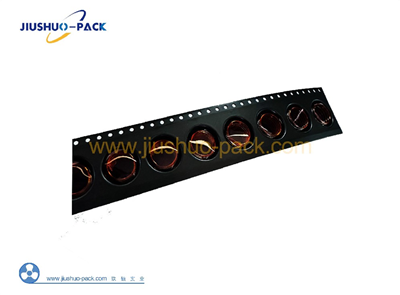
Let’s start with the basics: PET, or polyethylene terephthalate, is the most widely used material for standard carrier tape for good reason. It balances flexibility, tensile strength, dimensional stability, and cost far better than alternatives like polycarbonate (PC) or polyvinyl chloride (PVC) for most mainstream electronics use cases. That’s why when customers come to me asking for a standard product, our go-to formulations are optimized for PET, not specialty materials. But thickness isn’t just a random number here—it’s calibrated to two critical factors: the depth of the pocket (the indent that holds your SMD) and the total weight of the component being transported.
For the most common “standard” carrier tape, which follows the EIA-481 international standard (the industry benchmark for SMD packaging), the core thickness we supply is 0.254 millimeters, or 10 mils. Wait—10 mils is the standard? Let me break that down to make it tangible: a mil is one-thousandth of an inch, so 10 mils works out to roughly a quarter of a millimeter, or about the thickness of a standard sheet of notebook paper two stacked together. But why is that the standard? Let’s look at the context. The EIA-481 specification was developed decades ago for mass-produced, mid-weight components: resistors, ceramic capacitors, diodes, and small integrated circuits with a weight of less than 10 grams per component. For these parts, a 0.254mm PET carrier tape strikes the perfect balance. It’s rigid enough to resist stretching during spooling (when the tape is wound onto a reel for shipping), so it won’t slip in the pick-and-place machine’s feed mechanism. It’s flexible enough to conform to the shape of the pocket, so the edges of the pocket don’t crack when you drop a reel from waist height, a test nearly every component importer runs. And it’s thin enough to keep the total reel compact, reducing shipping costs for customers who send reels across continents.
But here’s the part that surprises a lot of first-time customers: “standard” isn’t universal. We get calls all the time from folks who’ve been told they need a “standard” tape, only to realize their component needs a different thickness. For example, if you’re handling larger, heavier parts—like quad flat packages (QFPs) or small connectors that weigh over 10 grams—you’ll need a thicker tape, typically 0.305 mm (12 mils). This extra thickness adds structural integrity to the deep pockets required for these larger components, preventing the pockets from deforming when the reel is under tension during high-speed feeding. Conversely, if you’re working with tiny, ultra-light components like 01005 resistors (the smallest common SMD, measuring just 0.4mm x 0.2mm) or micro-LEDs, a thinner 0.203 mm (8 mil) PET tape works perfectly. The thinner material bends more gently around the small pockets, reducing the risk of creasing that could cause the tiny components to shift during transport.
It’s not just component weight that determines thickness—pocket depth is another key factor. Carrier tape pockets are formed either by thermoforming (heating the PET sheet and sucking it into a mold cavity) or, for smaller runs, laser cutting. The deeper the pocket, the more the material is stretched, and the thinner it becomes in the center of the pocket. For a pocket depth of 1.5mm (common for 0805-sized components), a 0.254mm starting sheet will stretch to about 0.18mm at the deepest point—enough to protect the component without being too flimsy. If you have a 2.5mm deep pocket for a larger SOP package, a 0.305mm starting sheet will stretch to a still-resilient 0.21mm, whereas a thinner sheet would stretch to just 0.14mm, too thin to prevent the pocket from collapsing during feeding.
Another often-overlooked detail is reel size and spool tension. If your production line uses 13-inch reels (the most common size for high-volume assembly), the 0.254mm standard thickness is ideal. It has just the right tensile strength to handle being wound tightly onto a 13-inch spool, so the tape doesn’t unravel or develop gaps that cause components to fall out. For smaller 7-inch reels used for low-volume prototypes, you can even go as thin as 0.178 mm (7 mils), since the smaller diameter means less tension on the tape during feeding. But for 15-inch reels used in some automotive electronics manufacturing, we’ve seen customers request 0.356 mm (14 mil) tape—automotive parts require extra durability to withstand harsh shipping conditions, and the larger reel size adds more stress on the tape, so thicker is better here.
Let’s address a common misconception: some people think thicker tape is always better. But that’s not true. Thicker PET tape costs more, and it adds unnecessary weight to reels, increasing shipping costs. It also requires more force to feed through the pick-and-place machine, which can wear down feed wheels faster and lead to misfeeds if the machine isn’t calibrated for thicker materials. We once had a customer who switched to 0.305mm tape for their 0603 resistors “just to be safe,” only to see a 15% increase in misfeeds because the thicker tape didn’t bend as easily around the pick-and-place machine’s rollers. After switching back to the standard 0.254mm tape, their misfeed rate dropped back to under 1%, which is the industry average for SMD packaging.
So how do we at our company work with customers to get the thickness right? We start with a simple conversation: what components are you packaging? What pick-and-place machine do you use? What’s your shipping process—are reels handled by air freight, ocean, or local delivery? For most mainstream electronics, the standard 0.254 mm (10 mil) PET carrier tape fits the bill. But for every request, we test a sample: we thermoform the tape to match their pocket design, feed it through a test machine to check for misfeeds, and drop a sample reel from 3 feet to ensure components stay secure. We’ve found that even slight variations in component size can change the ideal thickness—for example, a batch of 0402 capacitors that are slightly thicker than standard will work better in 0.254mm tape, while thinner capacitors might be fine in 0.203mm.
Another point to mention is that standard thicknesses also align with cover tape compatibility. Cover tape is the thin film that seals the top of the carrier tape’s pockets to keep components in place during shipping. For a 0.254mm base tape, you’ll use a standard pressure-sensitive cover tape that applies just the right amount of adhesion to hold components but releases easily when the pick-and-place needle lifts the component during assembly. If you use a non-standard thickness base tape, you might need a custom cover tape, which adds cost and lead time—another reason why the 0.254mm thickness is so widely adopted as the industry standard.
Let’s put this in context for someone who’s just entering the electronics manufacturing space. If you’re prototyping a new product and only need a small run of carrier tape, sticking to the 0.254mm standard is the easiest choice. It’s readily available, it works with almost all commercial pick-and-place machines, and it’s the most cost-effective option. But if you’re scaling up production for a high-volume product or working with larger or heavier components, it’s worth discussing your specific needs with a supplier to adjust the thickness accordingly.
Now, if you’re wondering how to confirm the thickness of the carrier tape you already have—you can measure it with a digital micrometer, which is a tool every production line should have for quality control. Just make sure you measure the base tape away from the pockets, since the thermoforming process thins the material inside the indent. If you measure inside the pocket, you’ll get a lower number, which can be misleading. A common test: take a sample of your carrier tape, measure the thickness in the flat, unformed area, and that’s the number you should reference when talking to suppliers.
At the end of the day, the “standard” thickness of PET carrier tape isn’t an arbitrary number—it’s a product of decades of industry testing, calibration, and collaboration between materials suppliers, electronics manufacturers, and standards organizations like EIA. The 0.254 mm (10 mil) thickness is the sweet spot for most SMD packaging, balancing protection, feeding reliability, and cost. But it’s not one-size-fits-all, and a good supplier will tailor the thickness to your specific application, not just push the “standard” product.
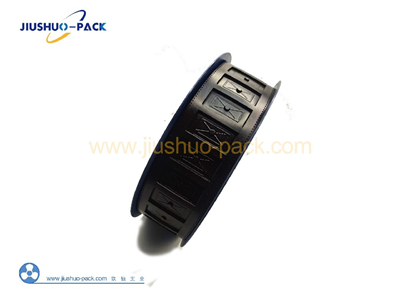
If you’re working on a project and need carrier tape tailored to your components, whether you’re a small startup prototyping a new gadget or a large electronics manufacturer scaling production, I encourage you to reach out and discuss your needs. We can provide sample rolls, test the thickness and fit for your application, and work with you to find the right solution to keep your components safe and your production line running smoothly.
Reel and Tape Packaging Machine References:
- EIA Standard RS-481-B, Surface Mount Device Tape and Reel Specifications
- Plastic Materials Europe, PET for Packaging Applications: Performance and Design Guidelines
- Electronics Manufacturing and Technology Association (EMTA), Carrier Tape Quality Standards for High-Volume Assembly
Dongguan Jiushuo Industrial Co., Ltd.
As one of the most professional carrier tape materials manufacturers and suppliers in China, we also support customized service. Please feel free to buy high quality carrier tape materials made in China here from our factory. Contact us for more details.
Address: 11th Floor, Building 2, Chuangfu Center, Chashan Town, Dongguan City, Guangdong Province, China
E-mail: sales06@zaidaiw.com
WebSite: https://www.carriertape-pack.com/
