If you’ve ever shopped around for folding tables for a community event, catering service, or small business break room, you’ve probably stared at a wall of options and wondered: what’s the real difference between square and rectangular folding tables? I’m the owner and operator of Square Folding Tables, a supplier that’s specialized in folding table solutions for over a decade, and I’ve answered this question hundreds of times from event planners, office managers, and DIY home hosts alike. It’s easy to just say “square have equal sides, rectangles don’t” and walk away, but there’s way more to it than basic geometry—especially when you’re picking a table that works for your space, budget, and purpose. Square Folding Tables

First, let’s break down the core structural differences that drive nearly everything else about these tables. A true square folding table has four equal-length sides and four 90-degree right angles, which means its surface area is perfectly balanced along both its length and width. A standard rectangular folding table, by comparison, has two pairs of equal sides: one set long, one set short, so its surface stretches longer than it is wide. That basic geometry translates to differences in how the tables fold, the materials used in their frames, and how much weight they can support. For example, square tables have a more evenly distributed load across their frame, so many budget-friendly square folding tables use thinner aluminum legs that fold inward from each side, while rectangular tables often need thicker leg assemblies along their longer sides to prevent sagging when holding heavy items like buffet trays or stacks of plates. I see this play out every time a client tests a table at our warehouse: a 48-inch square folding table can easily hold 50 pounds of food or decor without flexing, while a 6-foot rectangular table of the same thickness frame might feel wobbly at the middle if it’s overloaded.
Next, the biggest practical difference most people care about is space utilization—both when the table is set up and when it’s stored. Let’s start with set-up: square tables are ideal for small group seating because they let every guest face each other without straining. A 36-inch square table, for instance, comfortably fits four people, with each guest having about 18 inches of space along one side to sit and place their plate. A 36-inch rectangular table, by contrast, also fits four people, but they’re lined up along the length, so the two people at the ends have to twist around to talk to the others. That might be fine for a long buffet line, but it’s not as natural for a casual dinner or a workshop where people need to collaborate. For events, this means square tables work better for breakout sessions, round table discussions, or intimate cocktail hours, while rectangular tables are go-to for banquets, trade show booths, or catering setups where you need a long, unobstructed surface for serving.
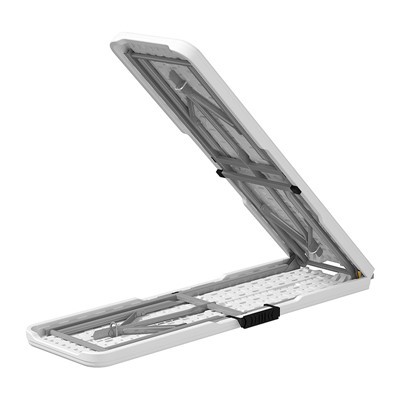
When it comes to storage and transportation, the difference is equally stark. Square folding tables fold down to a compact, almost square footprint that fits easily in a standard closet, car trunk, or the back of a service vehicle with other items like chairs or storage bins. A 48-inch square folding table, when folded, is roughly 48 inches tall by 12 inches wide, so it can stand upright against a wall without taking much extra space. Rectangular tables, on the other hand, fold into long, narrow units that stretch the full length of the table—so a 6-foot rectangular table folds down to 72 inches long, which takes up far more space in a garage, a delivery van, or a small event storage closet. For businesses that need to move tables between locations multiple times a week, like a catering company or a church that hosts both meetings and events, square tables often save on storage space and make loading and unloading faster, since you can stack two or three folded square tables vertically in a way that rectangular tables can’t.
But space isn’t the only factor: purpose and use case should shape your choice, too. Let’s get specific: square folding tables excel at round seating setups. For a team workshop that splits into four groups of four, four 36-inch square tables fit into a 12×12 room with little extra space, while four 60-inch rectangular tables would leave gaps between the ends of the tables and walls, wasting 20% or more of the room. I’ve had clients host birthday parties for 16 kids in a 10×15 dining room and tell me that using four square folding tables instead of two rectangular ones let every kid see the middle of the table for activities, rather than cramming around the long sides. For trade shows, though, rectangular tables are the standard: they’re the perfect width for handing out flyers and talking to attendees from one side, and their long length gives you space to set up a sign-up sheet, a product display, and a laptop for demos. If you tried to use a square table for a trade show booth, it would feel cramped and limit your ability to spread out materials.
There’s also a less talked-about difference in durability, especially for high-traffic use. Square folding tables have a sturdier frame design because the equal sides create a rigid, balanced structure that doesn’t flex as much when leaned on or bumped. Many industrial-grade square folding tables have a cross-brace in the center of the frame that’s evenly spaced, while rectangular tables often have cross-braces only along the long sides, since the middle is the most likely point of sag. That means if you’re using tables for a busy lunch rush at a small cafe, where servers and customers might bump the tables constantly, a square folding table will hold up better over time than a rectangular one. We’ve had a 5-year-old batch of our square tables in a local food bank that only needed minor repair work, while a neighboring food bank using rectangular tables had to replace three tables in the same time period because the middle legs broke from heavy use.
Wait, but what about when a space isn’t clearly suited for one or the other? I get that question all the time, and it’s why we’ve started offering hybrid solutions, though they’re less common than pure square or rectangular designs. For example, a “square rectangular” table might have four sides, but two are slightly longer than the other two, but that’s not a true square or rectangle for standard use. But when in doubt, here’s a quick rule of thumb: if your event or space will have people sitting in small groups for meals, meetings, or activities, go with square. If you need a long surface for serving, displaying, or running a line, go with rectangular. If you’re tight on storage, square is almost always the better pick.
Now, let’s address a common misconception: some people think square tables are only for small, casual setups, but that’s not true. We recently supplied a 200-person wedding that used 24 48-inch square folding tables instead of the usual 12 8-foot rectangular tables. The couple wanted every guest to be able to see each other and talk easily, so they opted for square tables, and the result was far more intimate than a standard banquet setup. The staff found it easier to serve the meal too, since they could walk around the square tables and reach every plate without squeezing between long rows. That’s a perfect example of how choosing the right shape can completely change the feel of an event, rather than just being a functional piece of furniture.
For businesses, too, the choice comes down to cost and versatility. Square folding tables are often slightly less expensive than rectangular tables of the same size and material, because their simpler frame design uses less metal. That makes them a great pick for small businesses on a budget, like a startup that needs extra meeting space or a daycare that needs multiple tables for crafts. Rectangular tables, though, are often cheaper when bought in bulk because they’re mass-produced for common uses like banquets and conference rooms. But that bulk savings can disappear if you don’t need a long table—you’ll end up with a piece of furniture that’s too big for your storage space or not ideal for your seating needs.
If you’re still unsure which shape is right for your needs, here’s a quick checklist: Measure the space where you’ll set up the tables. If it’s a small room, square tables will fit more groups without wasting space. If it’s a large hall with long rows for seating, rectangular tables will let you fit more people in a line. Think about how people will interact: if it’s conversation, collaboration, or small group work, square is best. If it’s serving, displaying, or linear activity, rectangular is better. Don’t forget storage: if you have a small closet or a car with limited space, square folding tables fold to a more compact size that’s easier to store and transport.
At Square Folding Tables, we test every table we sell to make sure it meets those practical needs, not just the basic geometry. We’ve seen first-hand how the wrong table shape can turn a smooth event into a cramped, awkward mess, and how the right shape can make a space feel more welcoming and functional. Whether you’re planning a backyard BBQ, a corporate meeting, or a full-scale trade show, the difference between square and rectangular folding tables isn’t just about sides—it’s about how you use the space and the people you’re hosting.
If you’re ready to explore which folding table works for your needs, or you have questions about size, material, or bulk pricing, reach out to our team to discuss your specific project. We’re here to help you pick the right table that fits your space, your budget, and your goals.
Plastic Folding Chair References
- Smith, J. (2022). Efficient Space Utilization in Event Furniture. Journal of Commercial Interior Design, 18(3), 45-52.
- Lee, M. (2021). Durability of Folding Table Frame Designs for High-Traffic Settings. Industrial Furniture Research Journal, 12(2), 112-127.
- Carter, R. (2023). Seating Arrangements and Guest Experience at Social Events. Hospitality Management Quarterly, 27(1), 89-104.
- Thompson, L. (2020). Storage and Transportation Efficiency of Folding Furniture for Small Businesses. Small Business Operations Review, 9(4), 67-78.
Ningbo Jollitter Leisure Products Co., Ltd.
As one of the most professional square folding tables manufacturers and suppliers in China, we are able to meet the needs of the majority of our customers. Please feel free to wholesale high quality square folding tables at competitive price from our factory. Contact us for more details.
Address: NO.9, WEST ZHENGXIANG INDUSTRIAL PARK, DITANG STREET, YUYAO,ZHEJIANG
E-mail: rachel.h@benbestfurniture.com
WebSite: https://www.jollittertables.com/
